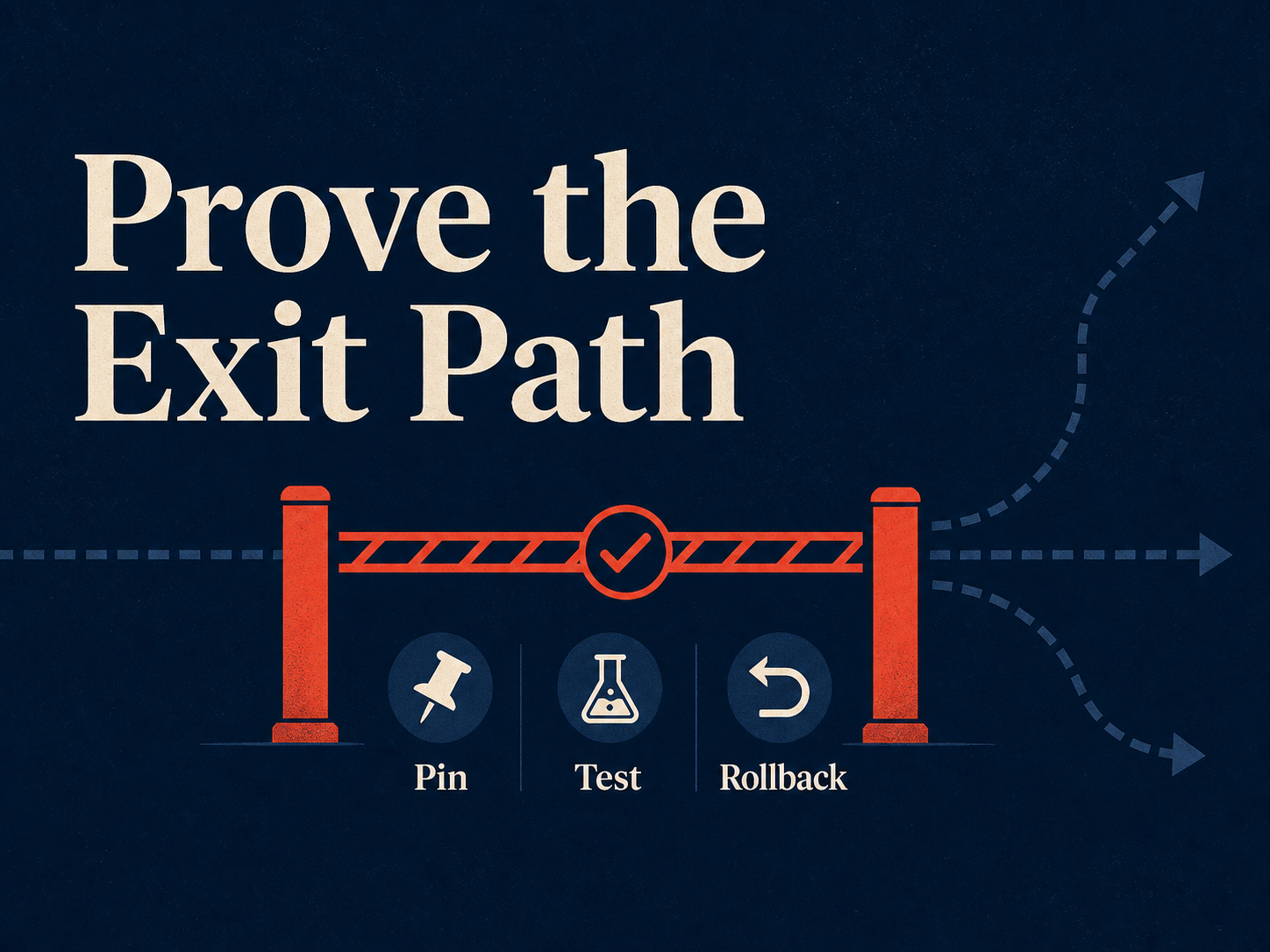
A beta dependency feels safe right up to the moment it becomes load-bearing.
The release note looks small: one adapter added, one selection bug fixed, one worker event improved, one alpha runtime tagged. You pin it in a branch, the demo works, and the pull request starts to look boring. That is the dangerous part. Boring demos hide the work that matters: how to reverse the change, how to prove the migration surface, how to stop a beta from leaking into production by accident, and how to keep the team honest after the first successful run.
TanStack Table v9.0.0-beta.26 was published on 2026-07-01 with a row-selection fix: parent rows can unselect child rows when the parent itself is not selected [Source: https://github.com/TanStack/table/releases]. One day earlier, v9.0.0-beta.25 added the Alpine Table adapter [Source: https://github.com/TanStack/table/releases]. Laravel Framework v13.18.0 landed on 2026-06-30 with worker, schedule, cache-header, and local dev orchestration changes [Source: https://github.com/laravel/framework/releases]. PHP 8.6 is an active development branch with Alpha 1 scheduled for 2026-07-02 and general availability targeted for 2026-11-19 [Source: https://php.watch/versions/8.6] [Source: https://benjamincrozat.com/php-86].
Those are useful signals. They are not adoption decisions.
This is the checklist I use before a moving library enters a real application. It is intentionally conservative. The point is not to avoid beta software forever. The point is to make the adoption reversible, measurable, and boring.
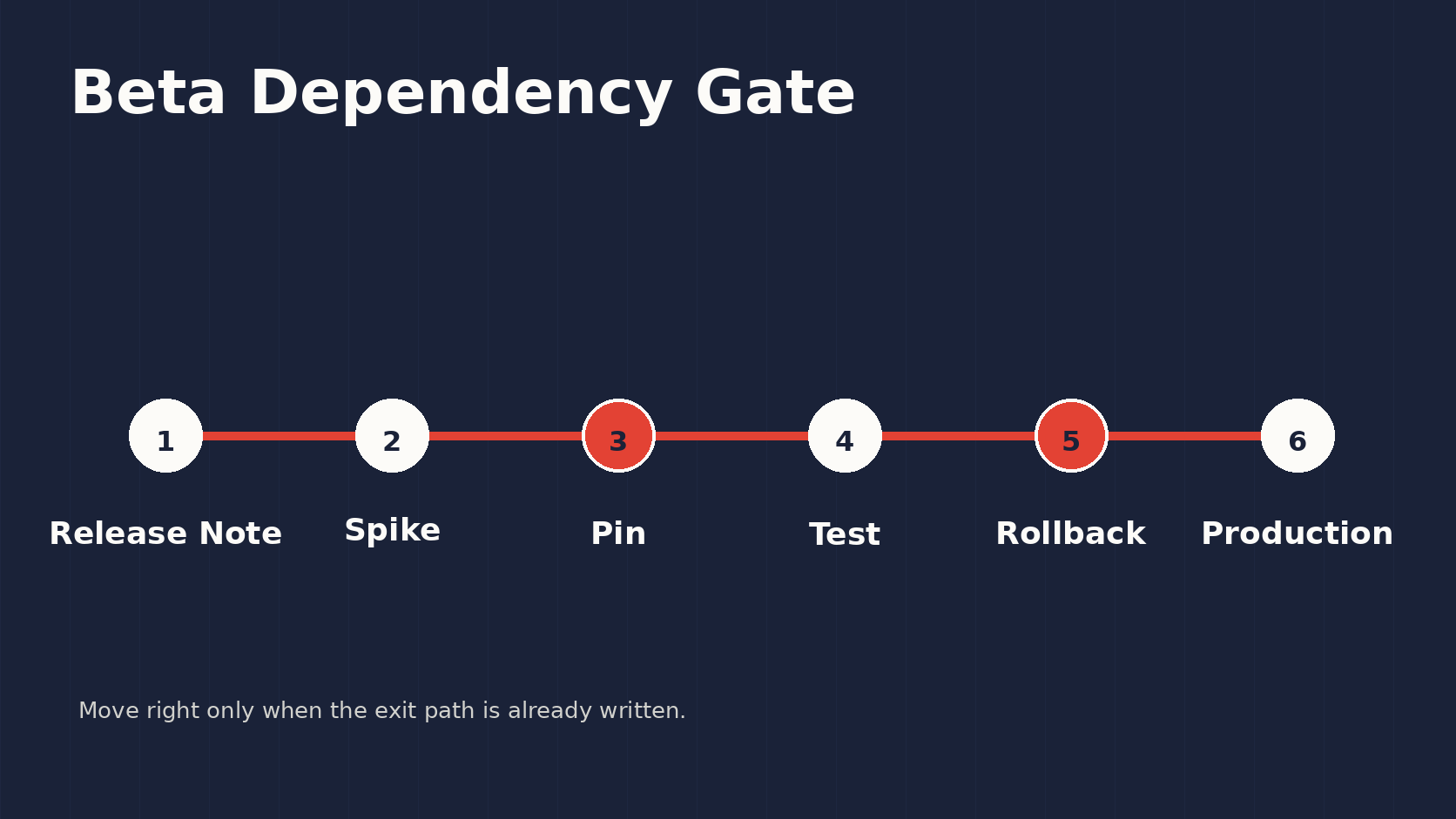
1. Separate the release signal from the production decision
A release note tells you what changed. It does not tell you whether your system is ready for the change.
TanStack Table v9 is a good example because the changes are concrete. The migration docs describe row model factories and function registries moving into feature slots, plus per-table meta slots [Source: https://tanstack.com/table/beta/docs/framework/react/guide/migrating]. The TanStack v9 blog also describes an easy migration path: subscribe to the full state and keep rendering from table.state if you want v8-like behavior during migration [Source: https://tanstack.com/blog/tanstack-table-v9-taking-form]. That is not a one-line patch in a complex table-heavy product. It touches state shape, feature registration, custom row models, test fixtures, and every place where table state is inspected.
Laravel v13.18.0 has a different shape. The release includes operational changes around worker events, schedule:work, artisan dev, cache headers, debounced jobs, and local dev command registration [Source: https://github.com/laravel/framework/releases]. Those changes are not scary. They are exactly the kind of framework maintenance release I want to keep close. But if a product has long-running queue workers, custom scheduler supervision, or deploy scripts around artisan dev, the upgrade still needs a focused regression pass.
PHP 8.6 is another category. An alpha runtime is not a production target for a normal Laravel app. It is a compatibility probe. You run it in CI, not behind the checkout button. The value is early warning: deprecations, extension issues, composer constraints, and test failures before the release train becomes urgent.
The rule is simple: classify the dependency before you argue about it.
| Dependency signal | Example from this week | Production posture |
|---|---|---|
| Beta application library | TanStack Table v9.0.0-beta.26 | Spike branch, explicit pin, feature flag, no broad rollout |
| Framework maintenance release | Laravel v13.18.0 | Patch candidate with targeted regression checks |
| Runtime alpha | PHP 8.6 alpha | CI compatibility lane only |
That classification prevents sloppy conversations. “Should we upgrade?” is too vague. “Is this a spike, patch candidate, or CI-only compatibility lane?” gives the team a decision they can enforce.
2. Pin the version before you write the experiment
The first mistake is letting the package manager float.
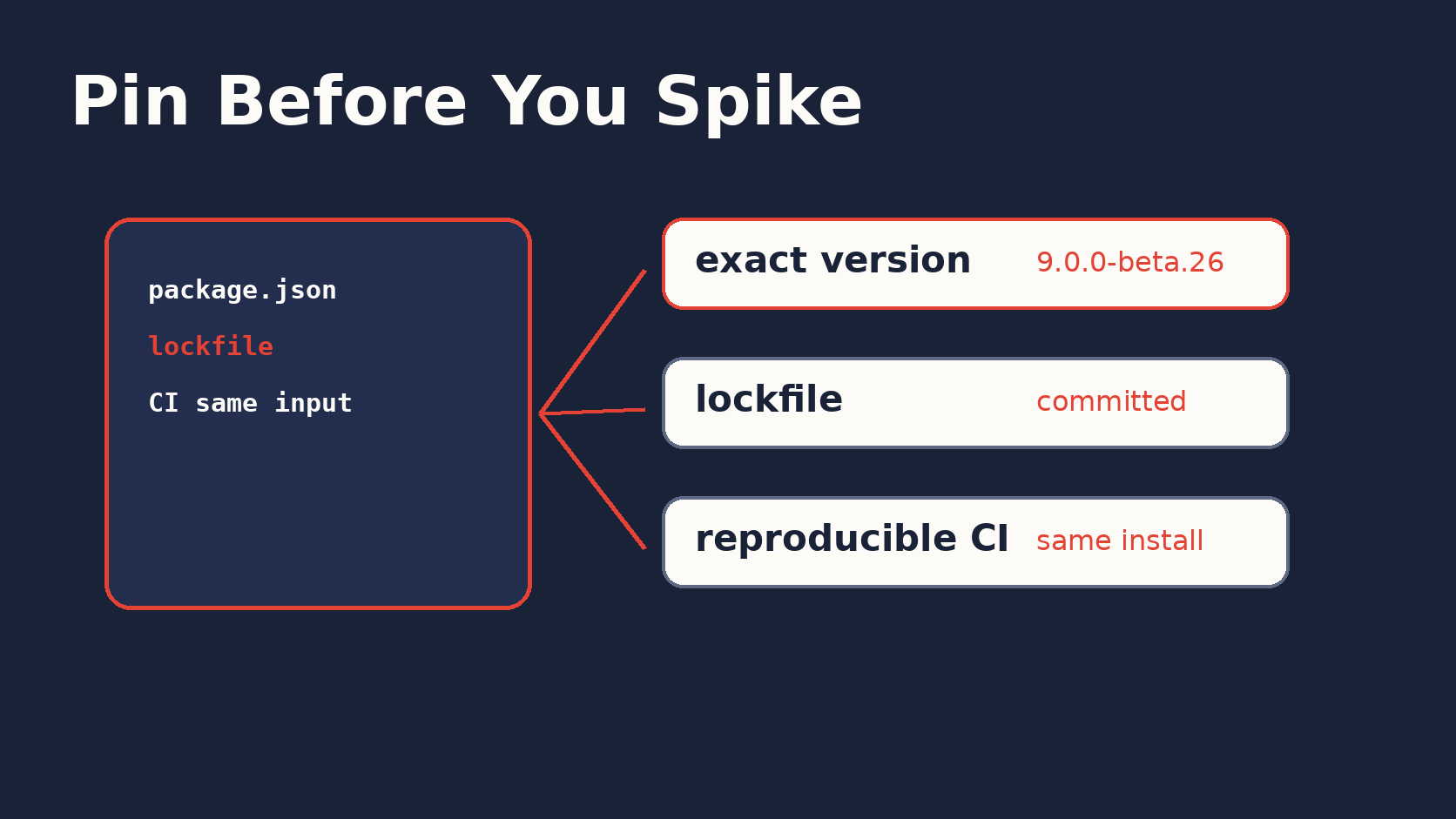
A beta adoption branch must be boring to reproduce. If the experiment passes today and silently installs a different beta tomorrow, the team has not tested a dependency. It has tested a moving target.
For JavaScript packages, I pin exact versions in the spike branch and commit the lockfile. I also add a small guard that fails if the dependency drifts. This looks pedestrian. It saves real hours.
| |
| |
Composer deserves the same treatment. If a Laravel project is evaluating a framework release or a PHP compatibility lane, make the constraint and platform explicit. Do not let a developer workstation and CI install different realities.
| |
The exact version is not bureaucracy. It is the audit trail. It lets you answer the only question that matters when a regression appears: what changed?
3. Map the migration surface before touching production code
A dependency upgrade has a blast radius. Find it before the branch starts rewriting files.
For TanStack Table v9, the migration surface is not “table package.” It includes feature registration, row model creation, custom sorting/filtering/aggregation functions, table meta typing, row selection, grouped rows, and any wrapper component that hides table state. The beta.26 row-selection fix is small, but the behavior matters exactly where nested selection UI is already complicated [Source: https://github.com/TanStack/table/releases].
For Laravel v13.18.0, the migration surface is different. I would inspect queue workers, scheduler commands, cache middleware behavior for HEAD requests, debounced jobs, and local dev orchestration scripts because those are the release-note areas [Source: https://github.com/laravel/framework/releases]. The framework release is not a reason to retest every screen manually. It is a reason to retest the areas the release touched.
I keep a simple dependency-risk file in the repository. It is not a replacement for issue tracking. It is a local map that travels with the branch and makes review concrete.
| |
The important field is rollback. If the rollback plan is “we will figure it out,” the branch is not ready. If the rollback plan is a revert, a feature flag, and a last-known-good package line, the team can take a measured risk.
4. Test the failure path, not only the happy path
Happy-path demos are weak evidence.
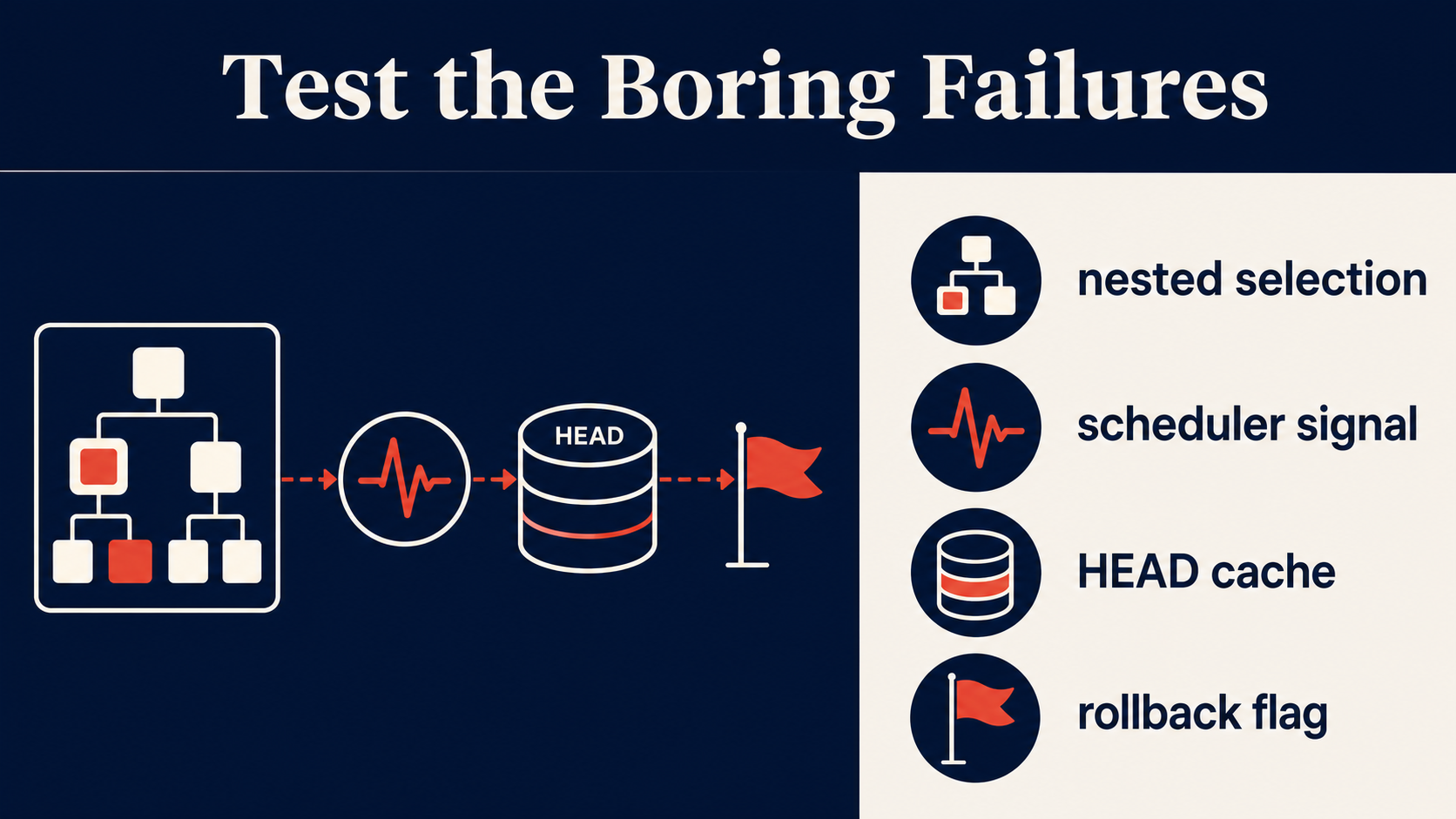
For a table library, the dangerous behavior usually lives in state transitions: selecting a parent row, unselecting a child, filtering while selected rows exist, grouping rows, clearing selection after data refresh, and preserving selection across pagination. That is why the beta.26 row-selection fix matters. It sits inside a state transition, not a screenshot.
A minimal test does not need the full product shell. It needs the behavior you plan to trust.
| |
This test is intentionally small. In a real migration I would add a second layer with the actual table instance and a Playwright smoke test around the product UI. The small test documents the behavior. The integration test proves the library wiring.
For Laravel, I want checks that touch the release-note surface. If worker events changed, assert worker observability. If scheduler signal handling changed, run scheduler commands in CI. If HEAD request cache headers were fixed, add a request-level test for that route class.
| |
A beta or framework upgrade earns trust by surviving failure-path checks. If the only proof is “the page loads,” the proof is thin.
5. Run alpha runtimes as compatibility lanes, not deployment targets
PHP 8.6 is the clearest boundary in this week’s stack notes. The active development branch is useful because it shows what is coming. It is not the version I would deploy for a normal production Laravel workload today. PHP.Watch lists PHP 8.6 as active development and expected toward the end of 2026 [Source: https://php.watch/versions/8.6]. Benjamin Crozat’s PHP 8.6 tracker lists Alpha 1 for 2026-07-02, feature freeze and Beta 1 for 2026-08-13, and GA for 2026-11-19 [Source: https://benjamincrozat.com/php-86].
That makes PHP 8.6 perfect for a CI lane.
| |
Notice fail-fast: false. I want the stable lane to keep reporting even if the alpha lane breaks. The alpha lane is a warning system. It is not a release blocker until the team deliberately promotes it.
That separation prevents drama. An alpha failure becomes a tracked compatibility issue, not a panic. A passing alpha lane becomes early confidence, not permission to change production runtime.
6. Keep the rollout small enough to reverse
The production decision is not “merge the upgrade.” The production decision is “merge a reversible slice.”
For a TanStack Table beta, that can mean one internal admin table behind a feature flag, not every customer-facing grid. For Laravel v13.18.0, that can mean deploying to a worker-light environment first, then watching queue metrics and scheduler behavior. For PHP 8.6, that means no production rollout yet; keep it in compatibility CI until the release train matures.
I prefer a two-column rollout record in the pull request description:
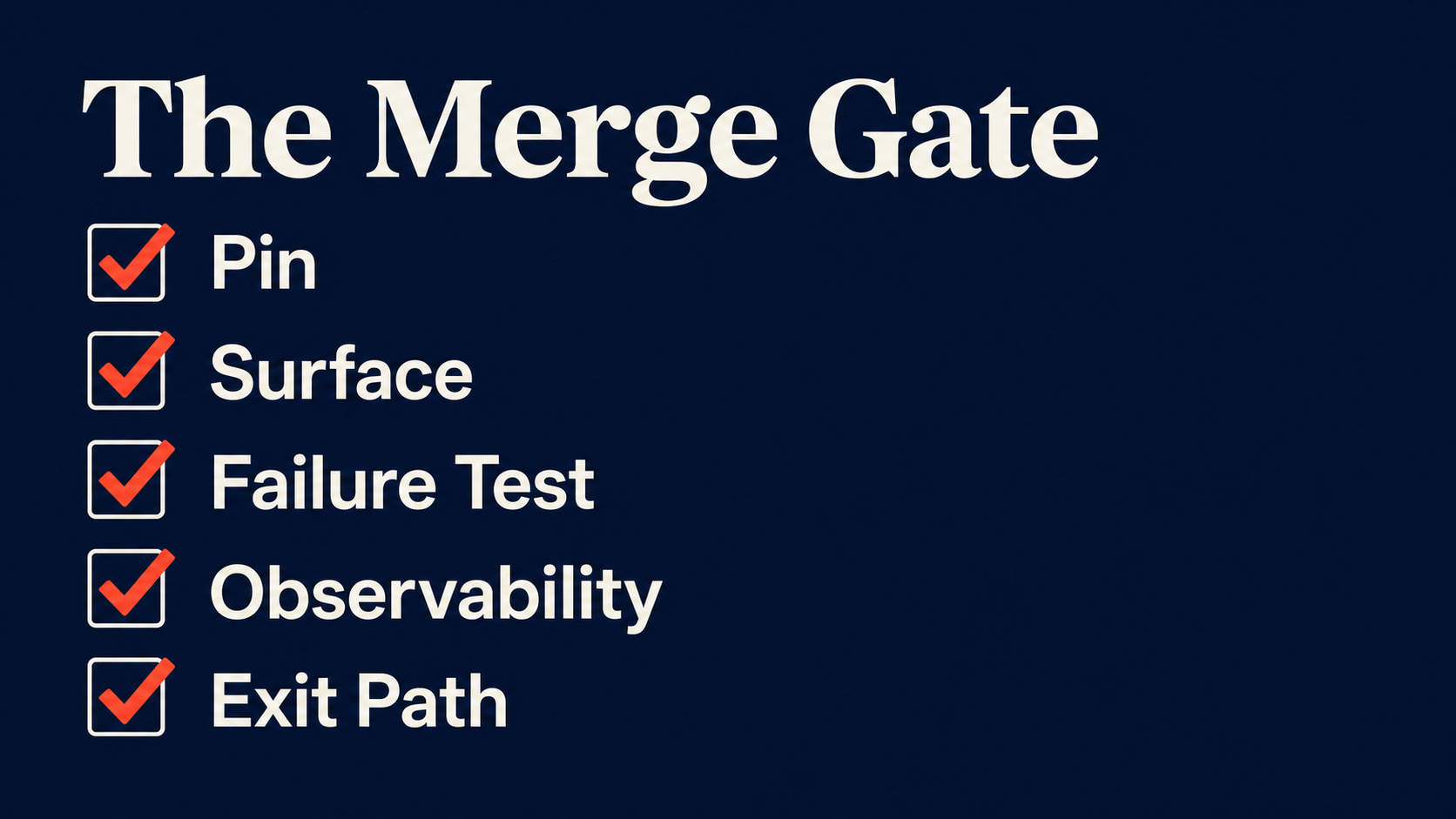
| Gate | Evidence required before merge |
|---|---|
| Version control | exact dependency pin, committed lockfile, rollback commit identified |
| Migration surface | list of wrappers, commands, workers, routes, and CI lanes touched |
| Failure-path tests | at least one regression test for the behavior the release changed |
| Observability | log, metric, or smoke test that proves the upgraded path actually ran |
| Exit path | feature flag, revert command, and last-known-good version documented |
That last row matters most. Teams get stuck not because they took a beta risk, but because they took an irreversible beta risk. Irreversible experiments are not experiments. They are unpriced commitments.
What you should do Monday morning
Do not start with the upgrade command.
Start with classification. Label the dependency as a spike, patch candidate, or compatibility lane. For today’s stack signals, I would treat TanStack Table v9.0.0-beta.26 as a spike, Laravel v13.18.0 as a patch candidate, and PHP 8.6 alpha as a CI-only compatibility lane.
Then do the mechanical work:
- Pin the exact version and commit the lockfile.
- Write the dependency-risk file before rewriting application code.
- Add one failure-path test tied to the actual release note.
- Add a rollback row to the pull request template.
- Run the alpha runtime only in a separate CI lane.
- Merge the smallest reversible slice, not the whole migration.
The practical question is not whether beta libraries are “safe.” That word hides too much. The better question is whether the team can prove the entry gate, the blast radius, and the exit path.
If the answer is yes, a beta can be a disciplined experiment.
If the answer is no, it is just a dependency gamble with a nicer changelog.
The review comment that catches most bad upgrades
The best review comment is not “why are we using a beta?” That question turns the pull request into a taste argument. It also pushes the author into defending the library instead of proving the integration.
Use this comment instead:
Show me the exit path.
That sentence changes the review. The author has to point to the pin, the lockfile, the touched surface, the failure-path tests, the feature flag, and the revert plan. If those artifacts exist, the discussion becomes technical. If they do not exist, the branch is not ready yet.
I also ask for one production-readiness note in plain English. Not a design document. Five bullets inside the pull request:
- why this dependency is being evaluated now;
- what exact version is under test;
- which application paths changed;
- what failure the new tests cover;
- how to roll back in one release window.
That note is useful months later. When a table regression appears after two more beta releases, nobody remembers the Slack thread. The pull request still knows the original boundary.
The same habit works for framework updates. A Laravel v13.18.0 patch branch can say: “This touches worker event visibility, scheduler handling, local dev orchestration, and HEAD cache headers. Queue smoke tests, schedule command checks, and request-header tests passed. Rollback is a framework version revert plus lockfile restore.” That is enough. It is also much better than “updated Laravel, tests pass.”
For PHP alpha lanes, the note should be even stricter: “CI-only. Not a deployment target. Failures create compatibility issues, not release blockers.” That one sentence stops an early-warning lane from becoming accidental policy.
A dependency upgrade is a small operations project. Treat it that way. Make the state visible, make the rollback boring, and keep the experiment smaller than the blast radius you can debug in one sitting.
There is one more habit worth keeping: remove the experiment after it succeeds. A feature flag that never gets deleted becomes a second product path. A beta compatibility script that nobody owns becomes stale theater. A pinned beta that stays pinned for months becomes its own risk. Put a cleanup date in the same pull request. Either promote the dependency to a normal upgrade path after the release stabilizes, or delete the spike and return to the last known good line.
That cleanup rule keeps beta adoption honest. The team is not collecting clever dependencies. It is buying specific product value with a fixed engineering budget. When the budget expires, the experiment needs a decision.
Further reading
- TanStack Table releases: https://github.com/TanStack/table/releases
- TanStack Table v9 migration guide: https://tanstack.com/table/beta/docs/framework/react/guide/migrating
- Laravel Framework releases: https://github.com/laravel/framework/releases
- PHP 8.6 tracker: https://php.watch/versions/8.6